
From Digital Design to Physical Parts How to Bring Your Complex Ideas to Life with CNC in Just One Day
Introduction
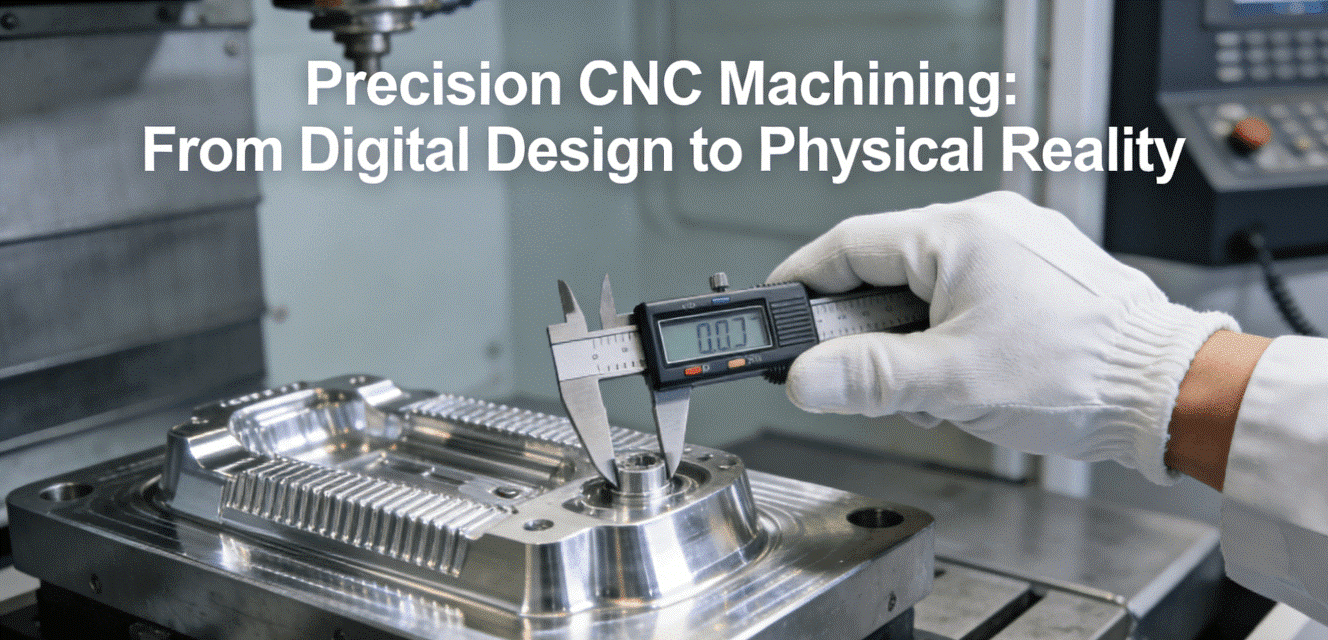
For digital designers, makers, and hardware startups, the most significant frustration is seeing a meticulously crafted 3D model deviate, lose detail, or face prolonged lead times when transformed into a physical prototype. This disconnect stems from the precision limits of manufacturing processes, material constraints, and inefficient communication.
This article analyzes how modern CNC machining services act as a precision bridge between digital and physical worlds. By explaining their principles and custom part production workflow, it shows how they ensure the accurate translation of complex designs from screen to reality.
Why Complex Digital Designs Often Get Distorted During Physical Realization?
A seamless digital design often encounters “distortion” in the physical world. This gap originates from several key factors.First are process limitations. In CNC machining tolerance services, a rotating cutting tool has a fixed radius, preventing perfectly sharp internal corners. Secondly, there is the issue of material properties, where plastics have a tendency to shrink during cooling, while metals have a tendency to warp during machining due to heat, thus altering their dimensions from those of the CAD design. Lastly, there is the issue of tolerance, where small inaccuracies can add up during the various stages of production.
Consider a custom 3D relief Emoji key chain. Its curves, fine text, and undercuts each demand specific manufacturing precision. Traditional methods struggle to ensure perfect consistency, where burrs or blurred details undermine the design.Therefore, materializing creativity accurately requires a standardized, digitalized, high-precision process. This is the core value of modern custom part production services.
What Exactly is CNC Machining, and How Does It Read and Execute Your Design?
“Computer Numerical Control” (CNC) machining is a “digital sculptor” that uses code to bring virtual designs into the real world through subtractive manufacturing. The process of CNC machining begins with a 3D design file in a specific computer-aided design (CAD) format, commonly in the STEP file. This is then imported into a computer-aided manufacturing (CAM) program, which converts the design into a machine-readable code.
This is then interpreted by the CNC machine controller, which accurately moves the cutting tool to remove material from a block and create the final product. The main benefits of CNC machining are the ability to accurately replicate the part and the ability to create complex shapes. The choice of material will depend on the need for an aluminum CNC service, as it is an ideal material for prototyping and is lightweight. In comparison to 3D printing, CNC machining has the advantage of material strength.
The Key to Part Success: What Does Precision Mean in CNC Machining?
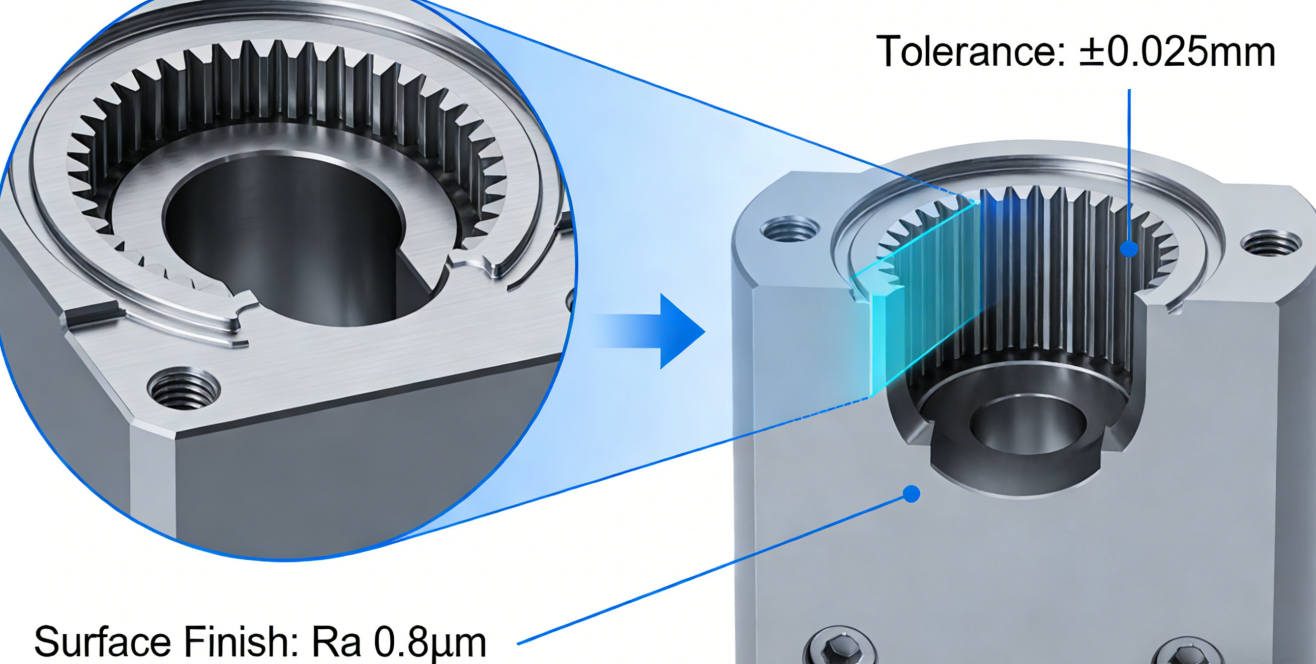
In CNC machining, “precision” is defined by quantifiable “tolerances.” Understanding tolerance is key to ensuring design intent is realized.
Defining and Ensuring Dimensional Precision
In summary, tolerances are the “contract” between design and manufacture. Tolerances specify the desired limits for part dimensions to guarantee proper assembly and function in the final product.
The Critical Role of Tolerances
Tolerance specifies the desired amount of dimensional variation. A ±0.025mm tolerance is finer than a human hair. When it comes to precise assembly, ±0.005mm or tighter tolerances CNC machining services are critical for part performance, function, and lifespan. This is not negotiable.
The Science Behind the Measurement
The validity of a tolerance is based upon metrology—the science of measurement. Global standards (e.g., from NIST) are in place to ensure worldwide consistency. This means a specific tolerance specified on a drawing can be precisely understood and achieved anywhere in the world.
How to Choose the Right Material and CNC Service for Your Creative Project?
The selection of the material as well as the service is vital in order to accomplish the custom machined part in a successful manner.Choices of Materials and Service: Aluminum Alloys like 6061 are the mainstay of the aluminum CNC machining service, as they are lightweight as well as machinable for use in frames as well as enclosures. Stainless Steels like 304 are strong as well as corrosion-resistant for harsh conditions. Engineering Plastics like POM are used in order to insulate as well as for wear resistance.
When looking for the best online CNC service, the following factors need to be taken into consideration: Is the service transparent in terms of quotations? Are the material as well as finish options available? Is there professional DFM feedback available? Are there credentials like case studies as well as quality certifications available? It is always better to order in small quantities in order to assess the quality of the service provider.
From File Upload to Delivery: What Does a Typical Online CNC Machining Process Look Like?
The Digital Workflow: From Upload to Order
This digital process eliminates traditional communication barriers, providing clarity and speed from the outset. It transforms a design file into a scheduled production order through automated and expert-guided steps.
Instant Online Quoting and Analysis
Clients upload a 3D CAD file, and automated systems generate an instant quote. This step establishes immediate project scope, timeline, and cost.
Professional Review and Order Finalization
Design for Manufactability feedback is given by expert engineers to optimize the design. Once the design is approved and specifications are chosen, the order is scheduled.
Precision Manufacturing and Global Fulfillment
Parts are machined on CNC machines, and quality control measures such as CMM are taken to ensure precision. Once machined, parts are shipped out globally. Hence, there is no need to look for CNC machining services near me; instead, efficient custom machining services are available. It is important to choose a certified company such as CNC Protolabs to obtain precision solutions.
Conclusion
High-precision CNC machining connects the digital and physical worlds. It is a technology that enables creative complexity. Tolerance and material understanding, combined with digital technologies, allow creators to confidently bring ideas into being.
Ready to bring your design to life? Try a professional online CNC service! Upload your file and get a quote and DFM report in real-time to start your project
Author Bio
The author is a manufacturing technology writer specializing in advanced manufacturing, supply chain digitization, and product innovation, building bridges between creators and manufacturing solutions.
FAQs
Q: Is the cost for small-batch or single prototype CNC machining very high?
A: Not necessarily. Thanks to online platforms and automated programming, the unit cost for small-batch CNC machining has been significantly optimized. For prototypes, their value lies in rapid design validation, avoiding more expensive changes during subsequent mass production. Overall, it is a cost-effective investment.
Q: How long does it typically take from order placement to receiving CNC parts?
A: Timing depends on part complexity and order volume. For prototype of general complexity, leading online providers can complete machining within 1-3 days. Adding logistics time,delivery usually takes one week. Specific lead times are clearly provided at the quoting stage.
Q: What types of files are acceptable for CNC machining that were created by the following types of 3D design software?
A: All popular CAD programs are acceptable. The important thing is that they are exported as STEP or IGES files. These file types are neutral and completely preserve all the details of the part.
Q: How do I decide between Aluminum and Stainless Steel for CNC Machining?
A: Aluminum is lighter in weight and easier to machine and less expensive. Stainless Steel is stronger and has more hardness and corrosion resistance.
Q: What are the steps I should take to ensure the CNC Machining company has the capability to achieve the tight tolerances specified on my drawings?
A: First, check the company’s publicly disclosed typical capability ranges. Second, inquire as to the quality control processes they have in place. For example, do they use Coordinate Measuring Machines for first article inspection and in-process inspection? Finally, inquire as to the quality system certification they have such as ISO 9001.